Following his solo recital at the Lithuanian National Philharmonic celebrating the birthday of M.K. Čiurlionis, Lithuania’s leading cultural weekly, 7 meno dienos, praised Maxim’s “turbo-virtuosity,” fearless phrasing, and inventive programming. Critic Daiva Tamošaitytė highlighted his seamless musical journey, moving from Čiurlionis to 20th-century American works, Romantic masterpieces by Liszt and Schumann, and his own imaginative encores—ultimately declaring Maxim “completely one of a kind.”
Read Original Article in Lithuanian (7MD.lt)
Originally published in 7 meno dienos on October 2, 2026, translated here to English:
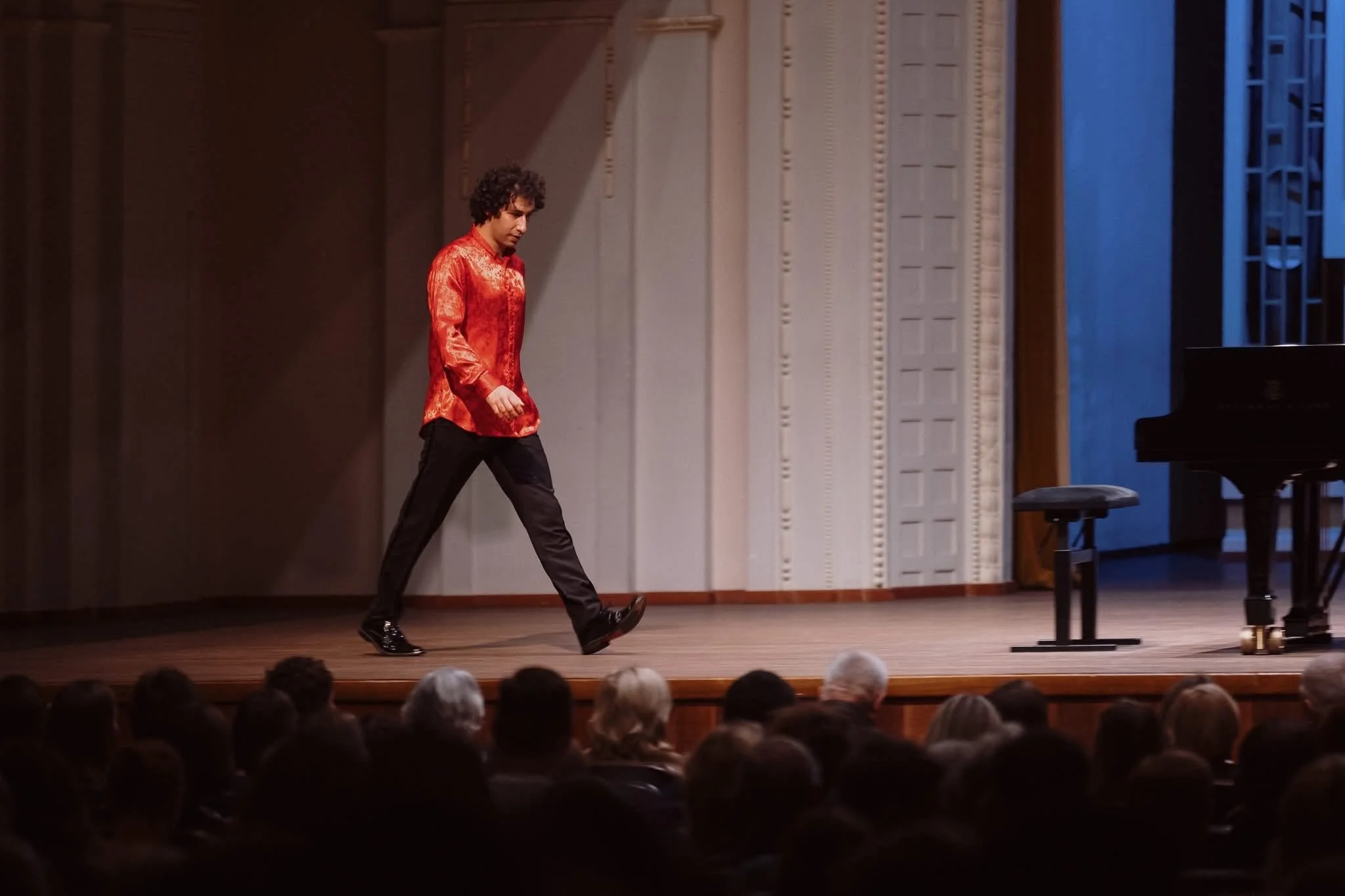
On September 23, the public institution Tytuvėnai Festival (artistic director Justas Šervenikas), alongside partners the Lithuanian National Philharmonic Society and the M.K. Čiurlionis House in Vilnius, organized a piano recital at the National Philharmonic by American virtuoso Maxim Lando, once again reminding Lithuania that we celebrate Mikalojus Konstantinas Čiurlionis’s birthday on the autumn equinox. The pianist had previously visited two years ago, and this time he presented an unusual concert concept, performing the pieces without pauses. In the first half, Čiurlionis’s opuses were interspersed with pieces by 20th-century American composers and various adaptations and arrangements of their works, while in the second half, we listened to the works of Romantic composers Franz Liszt and Robert Schumann.
The young pianist, born in 2002, is still studying at the Juilliard School under Hung-Kuan Chen, yet the international press has been writing about his concerts since 2017. That year, he performed at Carnegie Hall with Lang Lang, Chick Corea, and the Philadelphia Orchestra, receiving praise from The New York Timescritics, who were quick to notice one of his most visible traits—an infectious enthusiasm. His status as a rising star was solidified by a bronze medal at the 2024 Cleveland International Piano Competition. Another of Lando's traits—the courage to discover something new—was recognized the following year at the Napa Valley Festival (USA) with the Shahpar Khaledi Prize for Excellence and Innovation in Classical Music. Lando is also a laureate of the Artemisia Foundation, an alumnus of the Lang Lang International Music Foundation, and an active participant in top young artist platforms and radio programs.
Quite a few of Čiurlionis’s works were heard at the recital: Prelude in F-sharp major ("The Angel of the Lord"), VL 184; Songlet in E-flat minor, VL 199; Prelude in A minor, VL 230; Scherzo. Allegro Vivace from the Sonata in F major, VL 155; Impromptu, VL 181; Waltz, VL 144; and Nocturne, VL 183. From the very first note, the pianist presented a deeply immersed retrospective of Čiurlionis, listening intently and laying out the imagery slowly and sensitively. The Nocturne was particularly distinctive: in the outer sections, Lando highlighted the melodic lines, developing them impressively, while the middle undulation in the high register sounded matte, with the notes seemingly shimmering. This interpretation suited me very well, as it was simultaneously respectful and musically perceptive, yet matched the uniqueness of the pianist's personality, making it sound fresh.
Interspersed among Čiurlionis’s works were pieces of vastly different styles: George Gershwin–Earl Wild’s Etudes No. 4 "Embraceable You" and No. 6 "I’ve Got Rhythm" from the Seven Virtuoso Etudes cycle, Stephen Sondheim–Scott Wheeler’s "The Ballad of Sweeney Todd" from the musical Sweeney Todd: The Demon Barber of Fleet Street, William Bolcom’s "Graceful Ghost Rag," and David Chesky’s "Broadway" from the cycle New York Rags. Such an unexpected medley—ranging from the Gershwin etudes (the elegant fourth, gently rippling like Debussy’s imagery, and the impressively expressive sixth) to inventive, masterfully played-out opuses that utilized both the elbow and plucking the strings, as well as jazz-inflected pieces—felt thoroughly intriguing, as if participating in a cinema where through sound one senses an era and colors, the pulse of life, and moods. After this "rollercoaster," the Lithuanian lyricism and the Chopinesque Sonata movement sounded like a dialogue with another era, another continent. The exact same dialogue took place in the second half of the concert. This is an interesting perspective on program presentation, as the entirety felt like one long improvisation.
The pianist is exceptionally musical, commands the instrument effortlessly, and conquers any material with strong, agile, and nimble fingers. It seems the American virtuoso cannot be separated from jazz, the tradition of improvisation, and a certain aesthetic of lightness. At the end of the first half, Billy Joel’s song "New York State of Mind," which has become the unofficial anthem of New York City, was performed in an adaptation for piano by Lando himself, spontaneously evolving into themes from Gershwin’s Rhapsody in Blue. Here again, there was a great sense of relaxation, a pleasant conversation with himself, brilliant passages, and diverse musical textures gathered into a unified thought. The pianist captivated the audience with his fiery temperament—it was a magnificent conclusion to the first half of the concert.
In the second half, dedicated to 19th-century Romanticism, Liszt’s Hungarian Rhapsody in C-sharp minor, No. 12, S. 244, and Schumann’s Fantasie in C major, Op. 17 were performed. Here, Lando unfolded the full spectrum of his personality: a sincere rapport with the audience, ardor and temperament, enthusiasm, and turbo-charged technique. He addressed the listeners and spoke warmly about how all the music he plays is dear to him, just like his beloved New York, where he was born and raised. Čiurlionis and his oeuvre—which contains so many motifs, forms of expression, and colors—have become his newest love. Meanwhile, Schumann’s Fantasie, according to Lando, represents the love between Clara and the composer. He also joyfully recalled how, at around ten or eleven years old, he attended a Yevgeny Kissin recital and, among a dozen encores, heard the long-awaited twelfth Liszt rhapsody. Understandably, this must have left an indelible impression on young Maxim. His spirited interpretation of the rhapsody in this concert exceeded all expectations, making it clear at the same time that this pianist is completely one of a kind.
It was the first time I had heard someone treat the duration of a musical text—as a semantic musical structure—so freely when playing both Liszt and Schumann. Distinguished by his agile posture and clarity of thought, the performer seems to live in his own time. By manipulating and altering durations, he creates a separate, differently flowing cosmos filled with the gentlest lyricism out of slow episodes, movements, or entire slow-tempo pieces. And these cosmic bubbles become unique oases between fiery movements or other works. In the Fantasie, we heard numerous such bold departures in musical language and meaning from the conventional layout of the material, driven by an altered perception of agogics. Usually, only very experienced performers undertake such experiments.
Among Lando’s own adaptations were his encore performances of Led Zeppelin’s song "Stairway to Heaven"and arrangements of themes from Gioachino Rossini’s The Barber of Seville. These virtuosic treatments of slow and fast music became the climax of the evening, met with an extraordinary reaction from the audience.